


Bed rotting has become a popular escape for people in their everyday lives. Taking time out of their day to lie in bed for extended periods of time.
You would think it’s for rest, but in reality, it’s for passive activities like eating and watching TV. Many people often resort to bed rotting for many different reasons. This activity, however, poses more harm than help to people.
Bed rotting has been a problem for years, but was brought to light in 2023. Although it has been around for a long time, Gen Z has given it a name. This phrase was created to destigmatise and reclaim the activity as a form of self-care in opposition to hustle culture.
Bed rotting often stems from mental overstimulation and stress throughout the day, rather than physical exhaustion. Our phones and beds are the perfect places for that escape you’ve been looking for. They are easy to get stuck on instead of doing something mentally or physically challenging. Phones are easily accessible and good for just shutting off our brains.
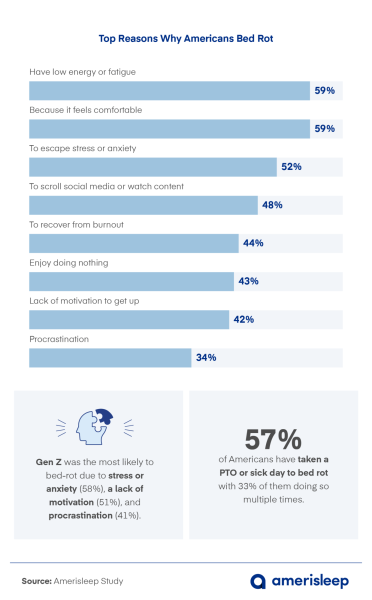
You can often find yourself scrolling through social media all day while lying in bed, forgetting about the anxieties that surround us in our daily lives. According to an AmeriSleep Survey, “The average American spends 364 hours a year bed rotting, equivalent to 15 full days.”
Although bed rotting serves as an effective escape from daily problems, it only harms your health. During your time spent bed rotting, you not only push aside your anxieties but also cut off social interactions. Isolating you from the world, becoming antisocial, and fostering a lack of motivation for activities outside your bed.
“The more that you isolate and the less you connect with people, the more it will only negatively affect your mental health,” said Mrs. Leanne Roy, a Nutritional and Wellness teacher at Oakmont.
Having your feelings and worries unchecked only fosters harm toward yourself. Furthermore, getting yourself accustomed to spending time alone in your bed on your phone can make social interactions and plans nerve-racking.
“Once you separate yourself from people, it’s going to be hard to get back to connecting with people. The support system and people you once had are not always going to be there to help you get back to connecting,” Roy states.
Decompressing is fine, but spending multiple hours of your day alone isn’t going to help your mental fortitude. There are better activities and things to do with the time spent bed rotting.
“Sitting all day in your bed on your phone, you’re just wasting time and good moments that can be made. We all have anxiety, but if you don’t push yourself further and face the problem, progressing in life will only become more of a challenge,” said Roy.
Doomscrolling – the act of consuming a large amount of news online, often compulsively and for long periods – is just another subfactor of bed rotting, usually being a huge part of it.
Many people find themselves endlessly scrolling on social media and consuming content. Most of the time, this content consists of negative news.
With a heavy consumption of negative news, negative thoughts can be formed. NOCD states, “If you’re frequently doomscrolling, you could put yourself in a cycle of hopelessness and depression that can feel difficult to escape. In fact, research reveals that spending excessive amounts of time on social media is associated with depression and anxiety.”
While not all doomscrolling consists of bad news, it remains a huge factor in bed rotting that should be avoided. You still end up spending hours consuming content, whether it’s good or bad.
While your screen time increases, the amount of sleep you get decreases. Your priority to sleep might become secondary when trying to get another dopamine fix from endlessly scrolling on social media. Avoiding the next day, which may hold more anxiety-ridden events.
Your bed isn’t supposed to be a place where you’re being active all day. Charlie Health says, “Excessive bed rotting can lead to linking the bed with being active instead of resting, and over-expose people to the blue light emitted by screens, potentially disrupting the sleep-wake cycle.”
Not only is your mental health at risk, but your physical health will also be a target during your long periods of bed rotting. There’s a possibility of weight gain, depending on your diet and whether you’re not getting enough exercise throughout the day.
Musculoskeletal pains are to be expected if you’re making this activity a continuous part of your daily routine, with Dr Galili stating in Cleveland Clinic’s, Is Bed Rotting Healthy?, “Being in the same position for a long time can lead to pretty bad neck, back, and hip pain. It can also leave your joints stiff and your muscles achy.”
An anonymous student at Oakmont has expressed their experiences with bed rotting. Stating that they can find themselves mostly rotting in bed on the weekends. The time spent rotting usually spans a couple of hours, but mostly lasts for around five.
The time spent rotting in bed is typically for moments when they are avoiding something. They find themselves to be procrastinators, trying to avoid the “real world and things like schoolwork,” which is due before Sunday ends and the new week starts.
Bed rotting has provided them with a needed break, but has also left them pushing important things aside. This has only had a negative effect on the way they feel. Instead of feeling refreshed and relaxed, it turns into guilt and regret.
“Although it’s nice to sit and relax once in a while, I usually feel guilty for rotting in bed for hours. I feel bad about myself when I do it, but I find myself in an endless cycle that I can’t break,” the Oakmont student said.
While addictive and hard to avoid, they believe that bed rotting is good in small doses. Once it becomes a frequent go-to escape, and longer than two hours, it becomes more of an issue.
While finding themselves caught up in the endless cycle of rotting, they’ve learned some ways to avoid and escape the activity. Saying, “I try to get out of my room, get some fresh air, maybe make myself a meal. I also try to get in some human contact. I think that reconnecting with family or friends kind of takes you out of that lonely state where it’s just you, your bed, and your phone.”
A senior at Oakmont, Natasha Hood, shares her experiences with bed rotting. She can find herself bed-rotting and on her phone for anywhere from “five to ten hours, depending on the day.” Mostly for that long on the weekends, with weekdays spanning just a few hours.
Hood often resorts to this activity when she has nothing to do during the day, but also states, “I’ll do it when stressed, but I don’t do it specifically to escape stress.” She believes that the activity is just something that can consume time spent with nothing to do.
During the time spent in bed, she doesn’t feel that there has been any impact or change on her mental fortitude. While NOCD stated, “excessive amounts of time on social media is associated with depression and anxiety,” Hood hasn’t had an issue with the amount of hours spent on her phone.
“As long as I’m not pushing important priorities and responsibilities aside, there isn’t a problem,” Hood states.
Furthermore, Hood escapes the time bed rotting by going to dance lessons, hanging out with friends, and spending time shopping.
Over the years, bed rotting has been recognised as a form of relaxation and self-care. People have grown to rely on the activity, using it as an escape from their worries. This, however, only creates problems for your social and physical life. Making it a daily habit and the first line of treatment for stress or depression can be very dangerous and have repercussions.