


As President Trump has begun implementing his immigration policies, prominent Democratic cities throughout the United States have seemingly erupted into war zones. The chaos and terror that have been televised in the city of Minneapolis have caused many to question the legitimacy and legality of I.C.E. operations and enforcement in the country.
Millions of Americans have witnessed the sheer level of force and manpower exerted on the state of Minnesota over the last few months, some with approval. But many others view it with disappointment and horror. Whether you agree or disagree with the politics of President Trump, it is worth noting the extreme measures being used against not only immigrants but also the American people. It’s also important to discuss and recognize the series of events that have led to this boiling point.
To be frank, immigration has never, and will never be, an easy problem to tackle. “Immigration has been an issue for my entire adult life,” expressed Mr. Dana Altobelli, a history teacher at Oakmont Regional High School and the current head of the Social Studies department.
However, the way it is handled and contained plays a large role in the general outcome it has on those affected.
In the US, there has been a history of negative reactions to foreign influence and “invasions”. In the 1920s, anti-immigration sentiments were mainly fueled by fears of economic competition, but also by religious and cultural biases. Responding to these feelings, Congress passed the Immigration Act of 1924, which placed strict immigration quotas on countries based on national origin. Aimed at promoting the past immigrant groups, it adversely affected those of origin from Eastern Europe and Asia.
Even in Boston, a generally progressive city, there is a dark history of nativism and prejudice. Global Boston, a humanities project run out of Boston College, reported on racist incidents fueled by nativism. In the 1980s, growing resentment against Southeast Asians infested the city. Over the decade, three Asian refugees would be killed by White assailants, and dozens more faced verbal, physical, and social harassment.
Then, in late 2001, the focus shifted towards Muslims following the September 11 terrorist attacks. Attacks against those profiled as Muslim or Middle Eastern were fueled by nativist fears.
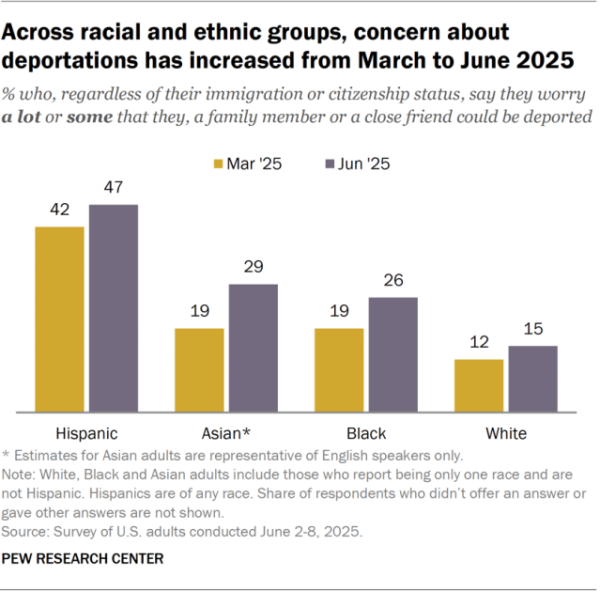
Now, over 20 years later, the same cycle is being repeated, with prejudice now being shifted towards those of Hispanic origin. According to the Pew Research Center, in June 2025 alone, 47% of deportees were of Hispanic origin, which calls into question the true messaging behind the Trump Administration.
Action is not where the Trump Administration stops, however. It’s in the rhetoric that has been spread over the past year, influencing the further divide in the U.S.
Most immigrants in the US have been marked with targets as President Trump continues to demonize their presence in the country. They continue to be labeled as criminal, un-American, and lazy, traits that almost everybody looks down upon.
Altobelli affirmed that this is not a mistake, but by design. President Trump did not invent the anti-immigration rhetoric in the United States, but he has profited from the American frustrations with immigration, and, most importantly, unfamiliarity with new cultures and experiences.
However, this is not the first time this has been used. During President Trump’s first campaign in 2016, harmful stereotypes and terminology were spread against Muslim and Hispanic Americans. Now, ten years later, the unfortunate truth is that things have not gotten much better.
The outrage and resistance against President Trump that was prevalent back then has exploded into a situation that puts opposing Americans at risk, and this has been seen in the city of Minneapolis.
Over 1,500 miles northwest, the people of Minnesota have helplessly watched their state turn into “an occupied city,” according to Altobelli. “There are 600 cops on the Minneapolis police force,” he detailed, “ and there are over 3,000 ICE agents in Minneapolis right now.”
It begs the question: If ICE’s job is to oversee immigration into all 50 states, what are 3,000 agents doing in just one US state? It all comes down to a project called “Operation Metro Surge.”
Operation Metro Surge was an ongoing ICE initiative launched by the Trump Administration late last year. It was originally meant to “enhance public safety, but targeting undocumented immigrants with prior criminal convictions,” according to Homeland Security Officials. Recently, on February 12, it was officially concluded, despite severe damage to the communities in Minnesota.
“ICE Law Enforcement are risking their lives to protect Minnesotans while their own elected officials sit back and do nothing,” said Tricia McLaughlin, the Homeland Security Assistant Secretary, “No matter when and where, ICE will find, arrest, and deport ALL criminal illegal aliens.”
The irony of the “protection” of Minnesotans is even clearer in recent months, with the deaths of civilians.
In January, barely two weeks apart, high tensions exploded and resulted in the deaths of Alex Pretti and Renee Nicole Good. Their deaths sent shocks throughout the country, as millions realized that this was not just an issue of immigration. President Trump’s rhetoric, in particular, has demonstrated that.
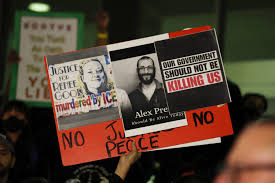
When asked to comment on the nature of the death of Renee Nicole Good, who was murdered by an ICE agent in broad daylight, officials within the Trump Administration had choice words.
In a press conference following the murder, Homeland Security Secretary Kristi Noem labeled Good’s actions “an act of domestic terrorism.” Vice President Vance furthered the theory, insinuating that protesters in Minnesota were using “domestic terror techniques” to intimidate ICE officials.
But how are unarmed people so “intimidating” to armed federal officials? It does not make sense, and people are showcasing their outrage, even locally.
Protests and backlash from Minnesota have inspired the students of a high school 13 miles up the road to jump into action. Just last month, Leominster High School students staged a walkout in protest of the increased ICE presence in the city.
Marching and chants echoed throughout the streets of Leominster as students exercised their rights against the US government. But the same levels of protest and the presence of ICE are not the same in other surrounding areas, including our own.
Andy Loescher, a student resource officer at Oakmont and a member of the Westminster Police Force, confirmed that there were no major issues in the Ash-West communities regarding ICE, and first responders in both areas have not been directly asked to step in to help ICE. In fact, they legally cannot help at all.
In 2017, the Massachusetts Supreme Court officially ruled in the case of Lunn v. Commonwealth. It was determined that local law enforcement lacked the authority to enforce a civil immigration detainer. But this state law has not been implemented everywhere.
“Several state legislatures in red states have passed state laws requiring local police, when asked, to assist ICE,” explained Altobelli. This paradox in state law does not just aid ICE; it causes more and more division in a country that has been divided enough over the past decade.
History always does find a way to repeat itself; it’s an unfortunate, but accurate truth. The similarities between the nativism and divide prevalent in the United States today and 100 years ago are cause for concern and discussion. But the way we react to hate and discrimination is important to spark the change necessary to finally close the chapter on this era of history, permanently.
“I thought we were starting to get to a point where things were a little bit better, but we’ve been set back decades,” said James Ethier, a history teacher at Oakmont. Will we continue to regress farther and farther into the past? Or can we fix the problems so deeply rooted in this country’s history and philosophy?