


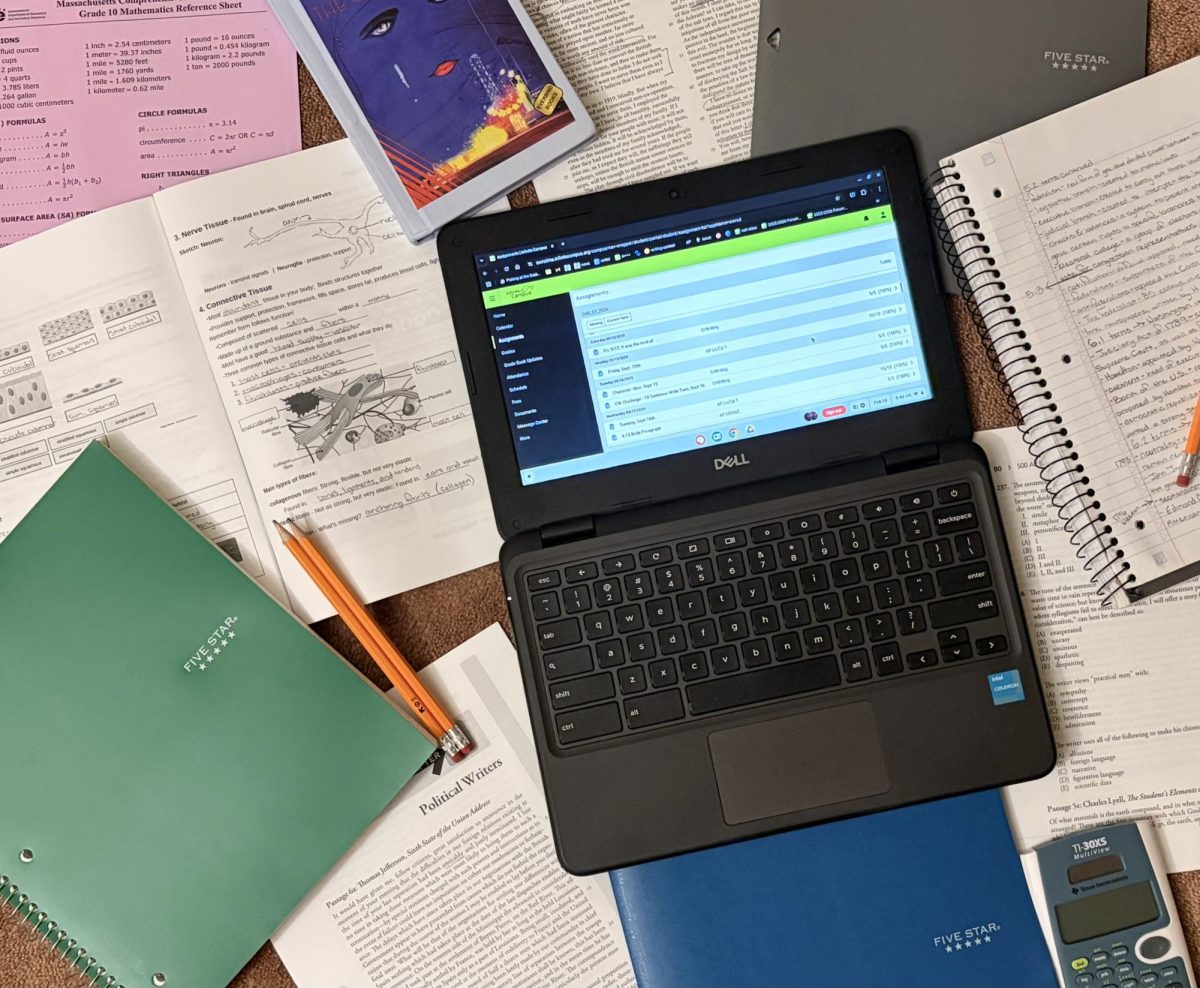
A global pandemic… suffocating masks… conversations through a screen… cameras turned off, Oakmont Regional High School students have been through it all.Six years ago, COVID-19 changed everything.
Not only did education shift to a hybrid compromise that left student learning in shambles, but it also took a toll on work ethic. Now, as the class of 2026 approaches high school graduation, their peers and younger generations are struggling to find the will to manage their workloads.
After a full year of online schooling, returning to in-person learning was a shock to students’ systems. And almost half a decade later, its effects are still weighing on kids, especially those nearing the end of their high school career.
But why is that?
While many people say students have recovered from the messy, COVID-era learning, those claims are not reflected in classrooms.
Freshman Lilah Scerbo said, “I think Covid made me more reliant on my Chromebook, and the online learning allowed for more breaks. I can’t work for a prolonged amount of time without getting restless.”
We have to face the facts – the pandemic permanently altered the education system, and schools today are still dealing with the fallout.
The UC Davis Office of Research conducted a study in late 2025 exploring the lasting effects of COVID-19. They found that, “As of 2024, California students are half a year behind their 2019 predecessors, remaining 31% of a grade equivalent below pre-pandemic levels.”
This comparative disparity between students is impacting young people’s educational growth, not to mention their drive to learn. Too many hours spent hiding behind a screen on Google Meets – barely completing online classwork – pushed work ethic to the back of students’ minds. With a year of learning essentially lost, these kids moved on to the next grade, lacking all the information they needed to be successful.
At Oakmont, students have been forced to get creative in order to combat decreased work ethics. Junior Lilly Bedard said, “[To motivate myself] I compare myself to other people.” And while tactics like these may improve grades, the Nation’s Report Card revealed that twelfth-graders across the country still scored lower in math and reading in 2024 than in 2019.
Many Oakmont students have employed similar strategies, finding themselves more motivated when essentially ‘racing’ against their peers. Scerbo said, “I motivate myself by rewarding myself after all my work is done or [after] I’ve been productive.”
Both approaches are improving work ethic in the school environment, and according to a National Library of Medicine study, “rewards delivered immediately after the experiment enhanced the participants’ intrinsic motivation.”
Yet, not all students are making the same changes to their study plans, and work ethic isn’t only unstable in schools, but also in the workplace.
The idea that students can get by putting in the least amount of effort is not a completely new trend. For years, as Gen Z has entered adulthood, they have begun prioritizing their mental health over work. A term has even popped up to describe this phenomenon: Quiet Quitting.
NPR explains the term as, “Quiet quitting doesn’t actually involve quitting. Instead, it has been deemed a response to hustle culture and burnout; employees are ‘quitting’ by going above and beyond and declining to do tasks they are not being paid for.”
Similarly, a memorable pop culture feline has also been pushing the low work ethic narrative: Garfield. The orange, cartoon cat of “I hate Mondays” fame first popped up in newspapers in 1978. Since then, his influence has had an enduring effect on older generations. But the recent 2024 film, The Garfield Movie, introduced the cartoon to Gen Alpha and younger Gen Z.
With the leftovers of COVID-19 and numerous references recommending different approaches, kids are unsure of how to approach school. This has bred a low work ethic, becoming drastically apparent in elementary/middle school-aged children. Many high school students even note that their younger siblings seem to lack the same ‘drive’ they themselves had at that age.
Bedard noted, “Covid didn’t really affect my work ethic, but it probably affected my youngest brother.” She also mentioned that there are certain subjects her younger brother was barely taught, but the school system moved on before he could truly understand the topic.
Students have become accustomed to doing the bare minimum and still getting a good grade, leaving them complacent in the education system. Yet, schools are beginning to show signs of improvement.
Oakmont students continue to correct the learning deficits that resulted from COVID-19 education, but their overall resiliency is improving. Students are taking on tougher classes and trying to make the best of their high school career. Overall, Oakmont is prepared for the future and what that might bring.
And as the class of 2026 prepares to graduate, all eyes are still on them to see if the pandemic altered their learning abilities, or if Oakmont has been teaching students new ways to learn.

Aubrey Chagnon • Mar 24, 2026 at 10:29 am
Wow! I love this big G!