

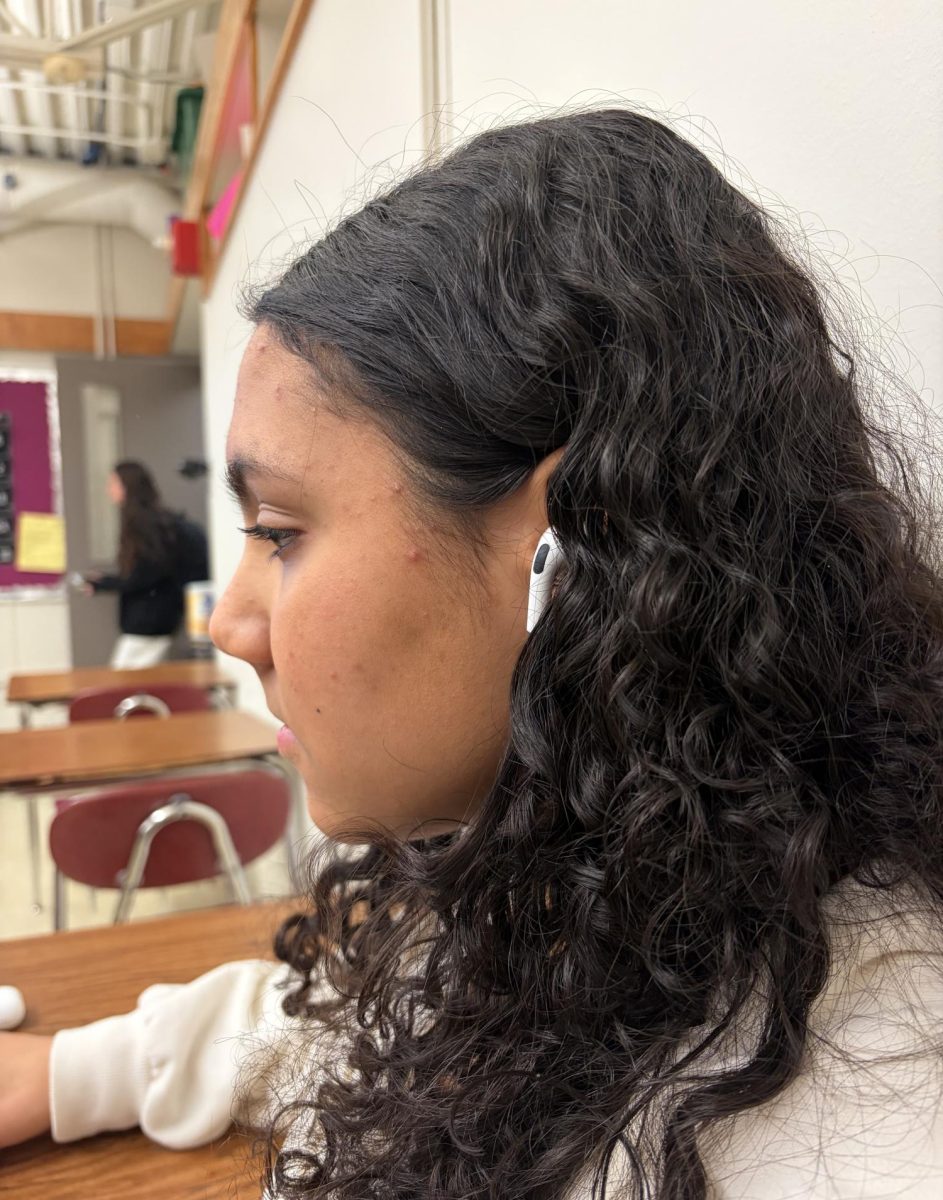
The words of those around them seem to fade as the volume of the music rises. The stress of the assignment seems to melt away as each key gets pressed. The rhymes of the music flow with the pressing of the keys, and before you know it, the assignment is done.
For some, this is just a scene. But for Oakmont Regional High School—and many other schools—students, this is a reality.
Whether you’re walking down the halls or sitting in class, you will see a large number of Oakmont students with AirPods in school. Wearing an AirPod and curating playlists to listen to when studying for a quiz is a social norm at Oakmont. But music is not just a source of entertainment; it has also been a way to help students improve their overall academic performance.
After speaking with Lucy Davieau, Piper Rigby, and Michelle Vuong—all sophomores at Oakmont—it was clear that students at Oakmont used music as a vital tool when learning.
“[Music] definitely helps me focus, and sometimes even makes the assignment less stressful,” said Oakmont sophomore Piper Rigby.
Michelle Vuong agreed, “It can also help me work a little faster.”
Students seem to be using music as a tool to help them focus on their work and get it done faster.
Lucy Davieau added, “Yeah, it honestly plays a huge role in how I can focus on my work.” she stated.
Research backs up much of what the Oakmont students had to say, like how listening to music can help them focus better.
Studies like Harmony and Healing show that when engaging with music, the brain changes, including the release of neurotransmitters like serotonin and dopamine. These enhance your mood and relax your body, helping you focus on things like schoolwork.
While other studies, like AfterSchoolMusicAcademy, add on to the positive impacts music has on students’ academic performance by showing how music can decrease stress.
Less stress for a student can lead to better academic performance because it ensures that students are able to put true thought into their work without overthinking it.
Furthermore, “A study in Psychology of Music found that classical or slow-tempo music lowers cortisol levels, the stress hormone (Thoma et al., 2013).”
This study introduces a new way to look at how music may affect students’ learning because it introduces people to new findings that the tempo of music, as well as the type of music, may actually affect learning in different ways. Which is something the interviewed students did not touch on.
With that being said, other things the students didn’t touch on were how music can improve sleep for a large percentage of teens. Better sleep equals better learning.
An experiment done by the Sleep Foundation found that “women with symptoms of insomnia played a self-selected album when getting into bed for 10 consecutive nights. Before adding music to their evening routine, it took participants from 27 to 69 minutes to fall asleep; after adding music, it only took 6 to 13 minutes.”
Although this research focuses on the way music affects sleep quality among women, men are still subjected to the same results. These results show that men and women can improve their sleep quality by listening to music, which in turn can boost productivity and help to reduce stress (Stanford Medicine).
This research is key to recognizing how music can positively impact students’ academic performance because music can help fix secondary problems that lead to academic failure (Like a lack of sleep/drowsiness).
Music can help to improve academic performance by helping students focus on their work as well as improving sleep quality, which in turn can help limit the stress and pressures of school work.
But, while these studies have shown that music can have positive impacts, there are other studies that counteract this claim and prove that music may also be distracting to students’ learning.
“Listening to music while studying can have an impact on a student’s ability to retain information. Students may score lower on reading comprehension tests when in a music listening condition as compared to studying in silence.” (NIH)
Music can distract students, which in turn can make it harder for them to process information in important readings. As shown by the study, this is detrimental to learning because it leads to lower reading comprehension levels.
Although this study presents a good reasoning as to why listening to music while performing academics may pose a negative thing, the positives seem to outweigh the negatives.
Music affects academic performance in both a positive and negative light, as shown by multiple studies and through student opinions.
But as Arthur Ashe, a professional tennis player and music fanatic, says, “Start where you are. Use what you have. Do what you can.”
If music works for you, use it, and if it seems to pose as a distraction, know when to recognize the areas where you see it negatively impacting your overall learning.