

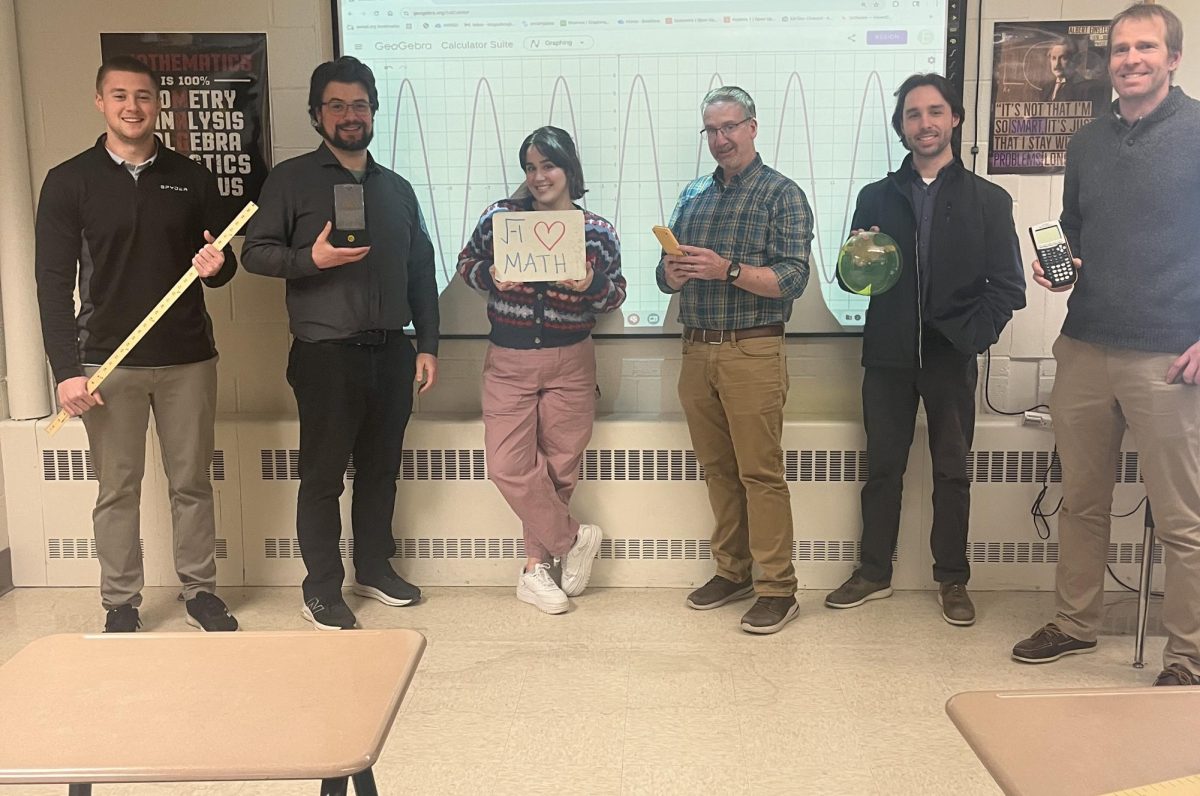
Question: Please comment on your intrigue or fascination with math. Maybe discuss a particular concept or unit that you find most interesting. Or, speak to the question, when will we ever use this math in real life?
Mr. Dylan Billings
Classes Taught: Pre-Calculus, Probability and Statistics, AP Statistics
I have the most fun in math when there are a variety of ways to find a solution, and I get a chance to be creative. It’s satisfying to find a clever method to solve a challenging problem. Math can be fun, but it does require a solid understanding of the fundamentals.
Trigonometric Identities give us the opportunity to approach problems with different strategies that are all valid. When your algebra skills are good, and you know all the Pythagorean identities, you feel like a sculptor with a full set of tools shaping the expression into whatever form you want.
Mr. Colton Bosselait
Classes Taught: Algebra 2, Algebra 2 Honors, Probability & Statistics
I came to enjoy math through studying physics in college. I was able to apply mathematical concepts that I learned growing up in real-world situations. This involved problem-solving and trying to approach these problems in different ways, but ultimately, there is always one correct answer to a problem.
Mr. Matt Brunelle
Classes Taught: Algebra I
At the start of each semester, when students enter Algebra I, I like to tell them that the concepts they will learn during the course will build them a toolbox full of math skills that they will be able to utilize throughout their educational experience in their future math, science, technology, engineering, and business courses. Algebra is a foundational math subject, so students can expect to use the different concepts they learned in the course for the rest of their lives.
Mr. Ed Logiudice
Classes Taught: AP Calculus, Algebra II Honors, Algebra 1 Additional Topics, Geometry
My answer to this prompt will answer both questions. What I find most interesting about math is how connected the topics are to each other. Topics you learn in earlier experiences in a math classroom show up in later classes. In elementary school, you are taught how to multiply. Well, that same skill is used in high school when you are taught how to multiply polynomials. Everyone knows the Pythagorean Theorem. But that famous theorem is used in virtually every math course in high school. The Pythagorean Theorem is used in the Distance Formula, the equation of a Circle, and even in Calculus when we are discussing Parametric and Polar equations. Also, the material you learn in one class is often the foundation for a new topic in a different math class.
So, when a student asks me, “When will I ever use this again?”, the answer is typically in your next math class. When I teach topics that I know will be used in later math classes, I will tell my classes when they will see this topic again. For many students, their experiences with various math concepts might end when they are finished going to school. Other students might choose to go into fields in which they will use these concepts. A lot depends on what an individual’s future plans are. As someone who has taught a long time, I will run into former students occasionally. When I do, they tell me how they use the math that I taught them in their everyday life. Whether they are a carpenter, an engineer, a statistician, an insurance adjustor, or an elementary school teacher. You never know when you will need to think back on some of the math concepts you learned in high school.
I want to end with a quick statement on the beauty of mathematics. It is one of the few topics that the entire world agrees on. The slope formula is the same in every culture and every language. The distance formula is the same everywhere you go. There is a new movie coming out, “Operation Hail Mary”. A few years ago, I read the novel by Andy Weir. Without spoiling too much, what topic do you think makes it possible for a human being to communicate with an alien life form? In a world full of variables, math is one of the few reliably constant topics that we have.
Mr. Charles Pappas
Classes Taught: Algebra 1, Algebra 1: Additional Topics, Algebra 2, Geometry
What interests me most about math is how it proves that numerical patterns and concepts are found in even the simplest things in life. For example, the Fibonacci Sequence has always been fascinating to me as it has a direct connection to the formation of different flowers and the number of petals they bloom. As the Fibonacci Sequence follows the pattern – 1, 1, 2, 3, 5, 8, 13, 21, 34, 55…- different species of flowers mirror it, as Lilies and Irises have 3, Buttercups have 5, Delphiniums have 8, Corn Marigolds have 13, and so on. In addition, the Fibonacci Sequence is found within the spiral patterns that make up each flower. Specifically, in a sunflower, its seeds are displayed in two sets of spirals, with the number of spirals in each direction typically being adjacent Fibonacci Numbers (34 and 55, or 55 and 89).
As the Fibonacci Sequence is just one example of patterns within the real world, coming to the realization of the abundance of those patterns truly shows how beautiful nature can be, even at its simplest pieces.
Mrs. Isabel Salovardos
Classes Taught: Algebra 1 CP, Algebra 2 CP, Algebra 2 Essentials, Advanced Quantitative Reasoning
What I’ve learned that fascinates me most about math is how patterns show up everywhere. A concept that I find really interesting is exponential growth and decay. At first, it just seems like another equation students have to learn, but when you start connecting it to things like interest in a bank account, population growth, or even how quickly something spreads online, it becomes much more real. I like seeing the moment when students realize that a simple formula can actually explain something happening in the world around them.
`I also get the question all the time: “Mrs. Sal, when will we EVER use this math in real life?” I don’t think every student will use every specific formula, but the real value is learning how to think. Math teaches students how to recognize patterns, solve problems step by step, and make sense of numbers in situations like finances, data, or decision-making. Even if they forget the exact equation later, those problem-solving skills are something they will use for the rest of their lives.
Ms. Rachel Sinclair
Classes Taught: Algebra 1, Geometry, Algebra 2, Advanced Quantitative Reasoning (AQR)
One of the questions students ask most often is, “When will we ever use this in real life?” The honest answer is that some of the specific procedures we learn in math class may not show up exactly the same way in everyday life. However, the real value of learning math goes far beyond the individual formulas or equations. Math trains your brain to think logically, analyze patterns, solve problems, and approach challenges step by step. In that sense, math is like a workout for your brain—it strengthens the way you think.
At the same time, many of the ideas we explore do appear in real life, often in ways students do not immediately recognize. Concepts from algebra help people understand finances, budgeting, and trends in data. Geometry shows up in design, construction, and art. In courses like Advanced Quantitative Reasoning, students learn how to interpret information, apply “everyday math” to real-world problems, and interpret graphs they encounter in the news, social media, and everyday decisions.
My hope for students is not only that they learn mathematical skills, but that they leave class more confident in their ability to think critically, make sense of complex problems, and persist when something feels challenging.