


Trackflation isn’t a common term, but it’s gaining traction in track and field circles. With a surge of teenage prodigies

in the sport, this word is quickly rising in popularity.
Track and field is one of the fastest-growing sports in the world right now. Competition is being pushed to the public more than ever. More options for streaming meets and social media coverage are also huge reasons for this rapid rise in popularity. But by far the main cause of this growth is the outrageous, world-class performances in every event. High schoolers are running times that can compete at the professional level and in world championship meets, and some are even earning medals at this high stage. These athletes and performances have coined the online term “Trackflation.”
Trackflation is a new term being used in the track and field world. It is taking place at different levels, from early middle-schoolers to high school runners, all hitting elite times and marks in their events. To put it simply, it is the massive, rapid improvement in performance, with young athletes achieving elite and ridiculously impressive results.
Whose fault is it, really?
Sometimes it seems like everyone online is “blaming it” on certain athletes. Saying that “they are the reason for trackflation” and for the crazy rise of fast times across the country. And it’s not just in the U.S. either; it’s all over the world. But is it all really true? Are these specific athletes causing the rapid improvement of the track world? Or is it other reasons, such as better training and nutrition, or better coaching? Or are athletes just evolving and getting faster and stronger overall?
If you follow track and field at all, and even if you don’t really, you have probably heard of some of these names: Quincy Wilson, Tate Taylor, Cooper Lutkenhaus, and Gout Gout. These are some of the fastest athletes in the world, and they’re only teenagers. Some hold high school national records, and even some have already earned world stage medals. The most recent crazy “trackflation” moment was when Texas high school junior, Lutkenhaus, won the indoor world championship in the 800 meters this late winter. But it isn’t just these athletes. There are teenage runners all around the world running times that could compete at the professional stage.

Breaking Barriers in the Sprints
Trackflation is in effect in every single event in the track space. More guys are running sub-10-second 100 meters and girls running sub-11 every year, and even more guys are breaking the once-thought-impossible barrier of a sub-4-minute mile.
High school 100-meter times have rapidly improved in the last decade, with 2024–2025 seeing multiple sub-10-second performances by high schoolers, breaking historic barriers and records. Elite high school boys are now frequently running below 10.20, a trend driven by faster starts, better overall mechanics, and more accessible coaching, making sub-10.00s a new, almost unreachable, expectation. Just last season, the national record was broken by 2 athletes, Tate Taylor and Maurice Gleaton, with a time of 9.92. This is a time fast enough to win 6 of the last 20 World Championship finals races.
And it isn’t just the guys breaking records. In 2023, North Carolina senior Shawnti Jackson broke the national record with a time of 10.89 seconds. This is also fast enough to win 6 of the last 20 world championships and is only the 3rd high schooler under 11 seconds in the 100 meters. She later went on to break NCAA records at LSU.
Right now, there is a prodigy running world-class times at the junior level, and the ridiculous thing is that she isn’t even in high school yet. 8th-grader Camryn Dailey has been setting age-group world records since she was only 11 and recently broke the U14 world record for the 200 meters. As long as Dailey stays healthy and clean, there is no doubt she’s gonna break countless records.
The 4-Minute Mile
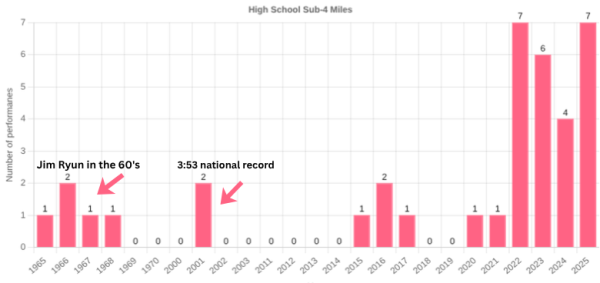
The 4-minute mile barrier was broken in 1954 by Roger Bannister. This was forever thought to be an impossible, unbreakable barrier, and supposedly, if it happened, your heart would blow up. Obviously, this is not true, but it was believed to be real. In 1965, Jim Ryun became the first high schooler to break this barrier, and many believe that with today’s technology, he had a chance at the modern world record. After a long, almost 40-year stretch of no one coming close, Alan Webb broke the national record in 3:53, which still stands today. Still, the number of young, high school athletes breaking the sub-4 barrier and getting close to Webb’s record has skyrocketed after 2021.
Gold Medals at 17
In the mid-distance side of the sport, two prodigies stand out to everyone. Quincy Wilson and Cooper Luktenhaus have shot to prominence in the past few years. In the 2024 Olympics, Wilson was part of the 4×400 relay that won gold in Paris. With a personal best of 44.1 in the 400 meters, he ranks as one of the best in USA history, and he’s only just turned 18 years old.
This past indoor season, Luktenhaus did something that has never been done at his age. He won a world championship gold medal in the 800 meters and became 6th on the all-time world indoor list with a time of 1:44.03. He recently signed a pro contract with Nike at only 17 years old, the youngest to ever do so.
Hedengren and Dudek, Changing the Sport
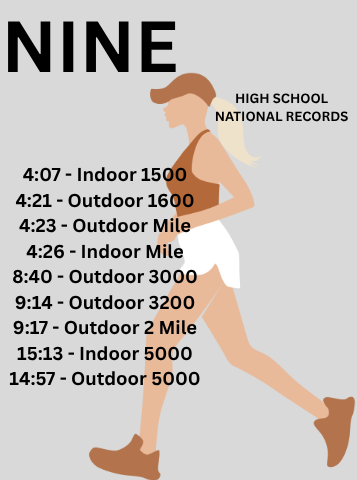
On the girls’ distance side, there are many notable names as well. Last year, the record books were completely rewritten by a senior from Utah, Jane Hedengren. In just 8 months, she broke 9 high school national records, ranging from the 1500 meters to the 5000 meters in cross-country. She is now running for BYU, and as a freshman, she already holds multiple NCAA records under her name.
High school sophomore Natasza Dudek has been a standout on the cross country and distance side this year. Having won 2 national titles in cross country and recently signed an NIL deal with Brooks, she is heading towards a very strong next few years in the sport.
“Supershoes”
Supershoes seem to be another explanation for why everyone has been so fast over the last few years. These specially designed shoes are a new technology used by runners to quite literally make you faster. They have a type of plate, either carbon fiber or plastic, embedded in the sole that returns energy out of the shoe, and it essentially pushes your legs to run faster. The first shoes to incorporate carbon fiber plates were produced by Nike in 2016. At the 2016 Summer Olympics in Rio de Janeiro, the top three finishers in the men’s marathon all wore Nike Vaporfly shoes.
High school cross country and track and field coach Matthew Brunelle ran at the Division 1 level, graduating from Fairfield University in 2012. During an interview, Brunelle talked about the differences in shoes and other track technologies, and how much they have changed in the last decade. “I think ‘trackflation’ is a product of not only the enhancements in the gear and shoes that are trained and competed in, but also of greater access to knowledge. For athletes, this, I believe, has had a huge impact because athletes are able to see what others their age around the world are accomplishing in their performances. Mentally, this can help make what seems impossible something that can be accomplished.”
Now it seems that if you don’t have the newest supershoe or superspike, you are pretty much at a disadvantage. Although this concept is relatively new, there are already many regulations governing the making and use of supershoes in the track world. All this research has inflated the sense of how much these shoes really do for you. Some believe they can shave many seconds off your PRs, but in reality, according to MIT Tech Review, it’s only about 2-3%, which is barely a few seconds in your race. But those few seconds can be the difference between winning and not.
Unlimited Access to Coaching and Nutrition
The basically unlimited access to coaching and nutrition is one of the biggest reasons for trackflation. All it really takes is to go to Google or even Chat GPT, and ask for a training plan for your goals, and within seconds, you can have a multi-week plan specifically tailored to you. Online coaches are also available to anyone who feels it’s worth spending some money. Another option is to go to YouTube, TikTok, or other social media, where you can find many coaches sharing their knowledge for free, for anyone’s use.
Nutrition is a huge part of improvement in this sport, and gaining the knowledge needed for it is easier to find now than ever. Online guides for runners of any level can be found anywhere. Overall, many people’s knowledge of nutrition has increased in the last decade. People are more aware of what they are putting into their bodies, and this has been an overall huge factor in the improvements of recent times.
The Future of “Trackflation”
In the boys’ running events, 13 of the 18 national records have been broken since 2021. As of right now, the field event records seem to be safe from trackflation. For the girls, 10 of the 18 have been broken, but similar to the boys, the field events have not been close to being touched in a while.
With how intense the competition has been recently, it wouldn’t be surprising if by the end of the decade, every single one of the high school national records has been broken. With everyone running faster times, it causes more people to have to train even harder and push their bodies past the limits every day to even keep up. It seems like every week, there is a new ridiculously fast time that now everyone else has to fight to compete with. Is all of this change good for the sport, or is it going to eventually lead to major burnout and cause these world-class times to slow down?

Cam • Apr 28, 2026 at 8:51 am
Very very good article Jayden I am impressed.
Jon Hood • Apr 22, 2026 at 11:24 am
I was shocked to get to the end of this article and see it was written by a HS student. I came her to read it as a HS coach looking for anwers to trackflation. This article was well written and lots of great information. Well done Mr. Brostrom.
Kenny Durkin • Apr 16, 2026 at 12:21 pm
Wonderful article