


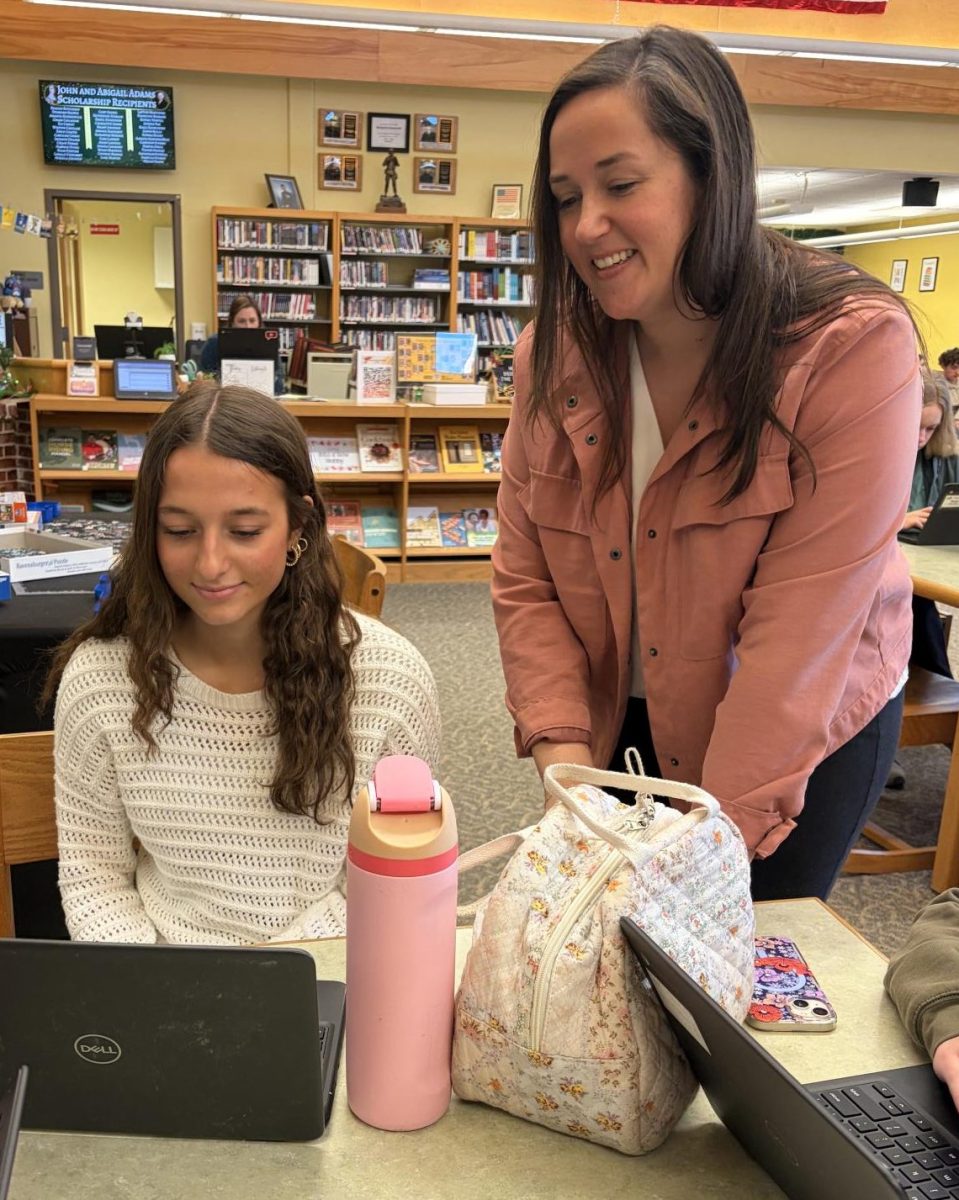
AP courses were created with the idea of a challenge. At Oakmont, the English department has shown they are ready to take on that challenge.
There are so many AP classes already within the English department. A student could take AP Literature if they like to read, or AP Language if they appreciate writing and grammar. And if English isn’t your strong suit, no problem. Honors and college prep classes are offered as well. There are even electives branching out of the English department, including Journalism and Sports Literature. Generally, AP classes are offered to juniors and seniors; however, some sophomores seem to think they can take on the weight of an AP course load.
Sophomore Piper Rigby said, “I’m glad they offered an English AP for us [sophomores] because it helps better prepare us for AP Language in junior year.”
As of the 2025-2026 school year, Oakmont has decided to implement a new AP program: AP Seminar. This course is offered to sophomores at Oakmont and is taught by Mrs. Amanda DiMauro.
Although this is only DiMauro’s second year at Oakmont, she brings a wealth of expertise with 14 years of ELA teaching experience. The push for this class was very important to DiMauro, as she saw the many benefits the class could provide.
She said “When I taught it at my old school, I really saw the benefits of the course. I think it’s very different from an [typical] English class and gets into research skills. In addition to that, presentation skills are a big part of it, and those skills are really helpful for college and careers in the future.”
While the class offers many opportunities, the workload is a challenge in itself.
This course curriculum had to be accredited and certified by the College Board.
The course is divided into three main parts: Performance Task 1, Performance Task 2, and the Final Exam. Each component (Part 1 and Part 2) is a certain percentage of the overall grade for the AP Exam, and each takes about a month to complete.
Course Structure
Students are first introduced to the AP class by getting to know the resources they are provided with and learning the basic regulations of the course.
A mock, or sample draft, of Performance Task 1 is done to allow students the opportunity to understand the process and rigor a project requires.
Projects are the main focus of this class. For the mock, the teacher will assign groups and a research question for everyone to use. It is the students’ job to create lenses, or viewpoints, out of the question, write their individual research reports (IRR), and to create their team multimedia projects (TMP). Essentially, the group will assign their teammates a lens relating to the question. From there, each student will write their IRR’s and then come together to create the TMP. This project is then presented to the teacher only and is recorded.
The Performance Task 1 is separated into two parts: the IRR and TMP. It is worth 20% of the overall exam grade, with each part being 10%.
The general rules to creating an individual research report are as follows: 1200 words (over under 10%), 5-8 scholarly sources using citations with proper and consistent formatting, and multiple perspectives. Sources should connect throughout the article, while also being able to provide a strong argument to the question. The team multimedia project on the other hand, has fewer requirements: 8-10 minutes long, oral defense questions, and minimal information on the slides.
During the mock presentation, teachers and parents are able to give feedback on what was done well and what could be improved on. But when it comes to the real performance tasks, that’s not the case.
During the performance tasks, only your peers can give you feedback and your teacher must only give general feedback to the class as a whole.
DiMauro shared her experience teaching this class, stating, “It is difficult, I’ve had a lot of students come and say ‘I don’t know if you can answer this’, and it’s hard not being able to tell them like ‘yes, no, fix this’. But I think there’s benefits from that which is that you guys [AP Seminar students] learned to rely on each other and get feedback from peers which is a great skill for the future.”
After completing this section, students will begin learning about the next step, which is Performance Task 2.
This consists of an individual written argument (IWA) and an individual multimedia presentation (IMP). This section is worth 35% of a student’s overall grade, with 24.5% being the IWA and 10.5% being the IMP.
In order to come up with a research question, students must review the stimulus materials given and relate their question to a common theme demonstrated in at least two of the stimuli.
For context, the stimulus materials are readings and articles provided by the College Board that each contain a theme that may connect the passages. Students must analyze the stimuli and see how they relate to each other. Only then can they proceed to the next step.
Then students can begin to develop a research question. The same rules apply in creating a research question in Performance Task 2: once a question has been created, the student must write a paper that incorporates one of the stimulus materials. It must be 2000 words, and at least 12 sources, with 8 of them being scholarly.
After two weeks, the IWA should be mostly complete and the IMP will begin. This is a 6-8 minute presentation with 2 oral defense questions.
This leads to the last part of the course: the final exam.
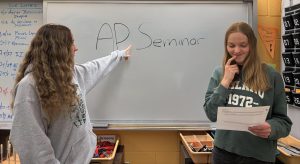
Once the two projects have been completed, the class will consist of preparation for the AP test. The teacher is allowed to elaborate more than previous projects and teach the class as a whole.
The exam consists of two questions, Part A and Part B. The first part is 13.5% of the grade and the second part is 31.5% of the grade. This is because the testing requires a passage to be read and each question is open response, with the second section consisting of three parts.
In addition to the workload this class requires, it is also only a semester-long class, meaning there is very little breathing room in between assignments.
Mr. Alex Dewhurst, English Department Chair, stated, “I wish it was a year long class. The block schedule doesn’t really help with that. It makes it tricky to have year-long classes. Especially like that one [AP Seminar].”
Students have also expressed their concern with the class being only a semester long.
Madison Bradley said, “I think since this class is only one semester long, which means we have a short amount of time to do the tasks, it can make it harder to perfect the writing parts of the course.”
The class may seem like a lot to some, but as DiMauro stated previously, the class provides many opportunities for students in the future. Students this year have shared their contentment with the class, with most saying that they got the chance to “get to know more people,” and “they loved being able to choose topics they were passionate about.”
Dewhurst mentioned that he also found the class to be beneficial to students, as it will set them up for their junior year AP classes.
DiMauro was behind the implementation of the course. Thankfully, teachers saw potential for this class due to its ability to set students up for success later on in their high school career.
Although this class is still new to Oakmont, DiMauro has shared that she has already seen improvement while watching her students transition into performance task 2 and is excited to see how the presentations turn out.
This class has clearly shown it has a place at Oakmont by providing students with a new understanding of presentation skills and argumentative writing.
While this class may not be for everybody, those who enroll will certainly be provided with a better grasp of college-level work.

Nora Brown • Apr 16, 2026 at 9:02 am
I really like this!
Addison Brodeur • Apr 16, 2026 at 9:00 am
Really good article!
Alyssa Breen • Apr 16, 2026 at 8:57 am
This encapsulates the course really well.
Reese dionne • Apr 16, 2026 at 8:57 am
great article!
Chloe Hewitt • Apr 16, 2026 at 8:50 am
great article