



Your teacher has been droning on for what feels like hours. Fighting to stay awake, you lay your head on the cold wooden desk, pencil twirling in your hand. The paper crawls under your fingers, and soon it’s been filled with squiggles and doodles as you let the pencil map out a story.
Doodling is when someone draws aimlessly on paper while their mind may be wandering off to a different place. It’s often seen as a distraction for teachers, but for many students, it can be a helpful tool to take in more information.
According to the National Institutes of Health, doodling is traditionally known for taking a student’s attention away from the teacher and is commonly considered poor classroom behavior. Still, in recent years, it has become a more promising route to improve the collective performance of many students.
Oakmont guidance counselor, Mrs. Kristin Brochu, feels that doodling can be a helpful tool, depending on how the students use it. “I think there’s the fine line of like completely tuning out and not doing what you’re supposed to be doing,” said Brochu. “But I think for a lot of students it can be a helpful way to focus their energy and listen.”
Brochu explains that at this age, students know what the expectations are and what they need to get done. Only when those expectations are not met do problems arise, such as a student simply tuning out their teacher and missing all directions given.
Mrs. Kristen O’Neill, an English teacher at Oakmont Regional High School, strongly believes that doodling on schoolwork is unprofessional, untidy, and a distraction. “Some people draw pictures, like full-blown cartoons that take up a whole paper, and I don’t like that because I think that work should be professional, [and] that there should not be doodling on it,” said O’Neill.
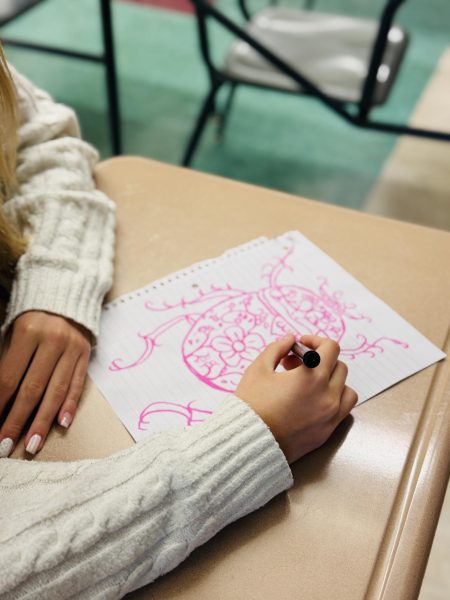
In the real world, you wouldn’t just turn in a paper with drawings on it when you’re working for any business; it’s very unprofessional.
Overall, in O’Neill’s opinion, doodling can be a major distraction in classrooms; students might not be listening or paying attention to the content that is being taught. It may not be a huge deal on your own time, but in high school, teachers are trying to prepare students for college and the reality of the real world. Teachers want students to meet expectations in the classroom that can improve productivity in their own lives.
Turning in papers that have huge drawings on them or crumbled-up edges is rather unprofessional. If parents asked about doodling, O’Neill would tell them it’s a big distraction.
Doodling dates back thousands of years. There is abstract art of shells carved on cave walls that date back over 500,000 years ago, making it a normal behavior for humans today. These carvings later became early forms of communication and storytelling.
An article titled, The Doodling Challenge, states, “In the 18th and 19th centuries, many famous presidents also were known to doodle, such as Thomas Jefferson, Benjamin Franklin, and Franklin D. Roosevelt.” Clearly, doodling isn’t limited to common folk, and it still goes on in modern day.
Oakmont freshmen Addison Roy and Tori McCullin both agree that teachers in high school don’t normally say anything about doodling, unless there’s a huge picture on the paper that distracts from work.
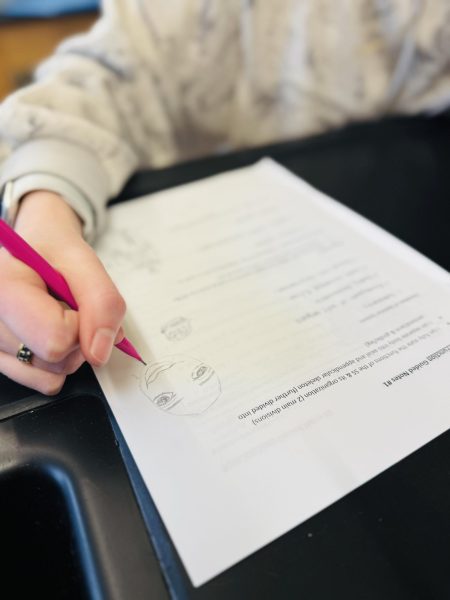
McCullin believes doodling is positive because it helps her focus in class. She usually draws flowers on the sides of her paper, which helps her listen to the material better.
Roy, on the other hand, finds doodling to be more of a distraction. “It is a negative because I can lose focus easily and don’t pay attention in class,” said Roy.“I don’t get the point of doodling when it doesn’t benefit me in any way.”
According to Harvard Health, in 2009, psychologist Jackie Andrade found and asked 40 people to listen to a two and a half minute, dull, boring, rambling voice mail message. She ran this experiment to prove whether or not doodling was beneficial for focusing attention.
Half of the 40 were assigned to doodle while they listened and the other half were not. During this experiment, the participants weren’t informed that they would be tested on their knowledge and memory of both the video and the voicemail message.
When asked to recall the details from the audio, those who had been doodling were recorded as having a better attention span and able to easily recall specific details.
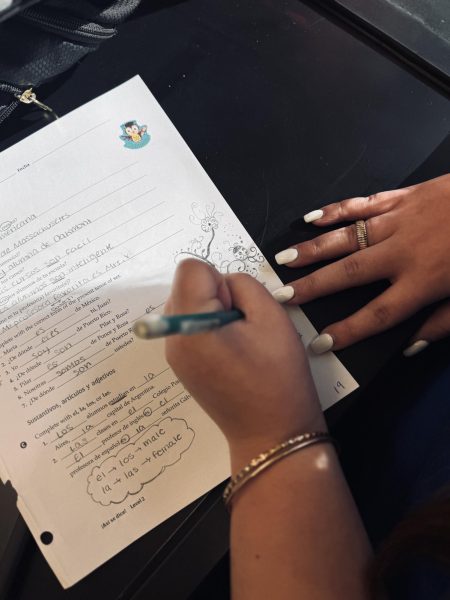
Statistics show that those who doodled were better at paying attention to the message and remembering the details. They recalled 29% more information than the participants who didn’t doodle. Students can actually benefit more from doodling than zoning out and losing information, which lets it go through one ear and out the other.
Centuries later, kids are still doodling. Teachers continue to complain, attempting to prepare kids for the reality of the real world. Whether you enjoy it or not, it seems like doodling is here to stay.


Aubrey Lauletta • Apr 29, 2026 at 3:30 pm
Absolute bombastic fire article, we want more
Gabby Comeau • Apr 29, 2026 at 1:45 pm
So good! Very interesting!
Bailey • Apr 29, 2026 at 12:13 pm
Absolutely fire, do more please